
Last Mile Fiber Services
Underground fiber drop installation
Fiber drop installation starts at the nearest distribution point, whether that is a pedestal, handhole, vault, or fiber distribution hub.
Seralex crews run buried drop cable from the distribution point to the subscriber building using direct-bury or conduit methods. Hard-surface crossings under driveways, sidewalks, and parking lots require horizontal directional drilling to place conduit without cutting pavement.
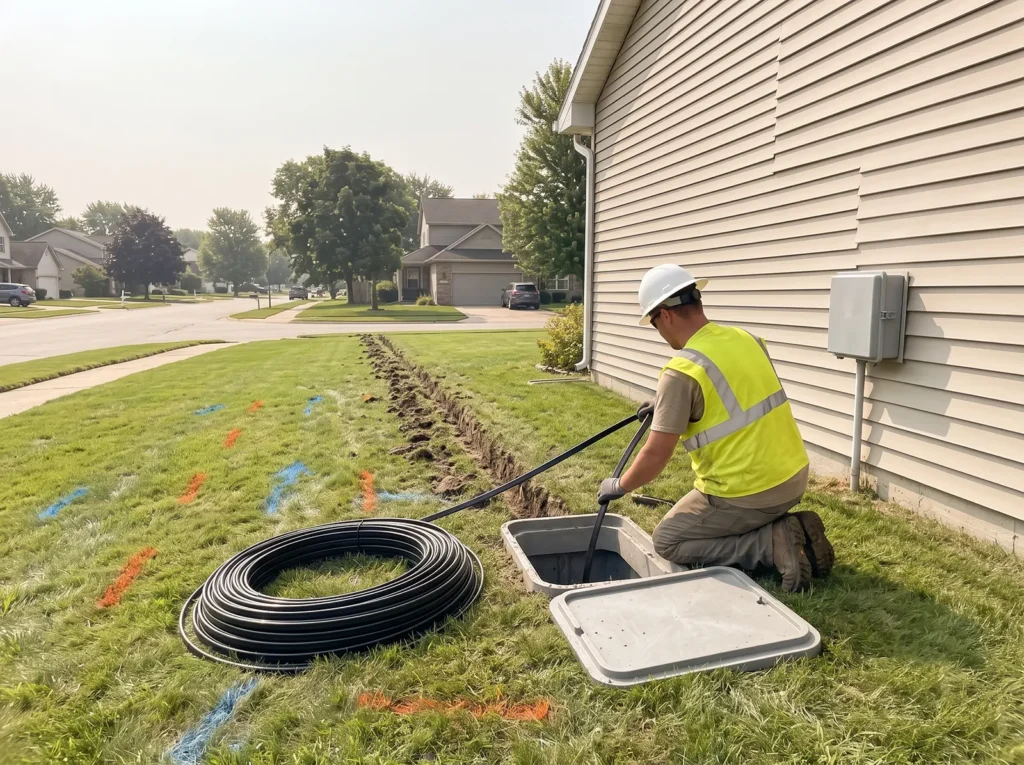
Every buried drop job begins with 811/Call Before You Dig coordination. Seralex schedules utility locates before any ground disturbance and restores the work area after burial.
Drop cable selection depends on the ISP’s provisioning standard. Most FTTH (Fiber to the Home) installation projects use flat drop cable with a pre-connectorized SC/APC or OptiTap termination at the building end, which eliminates field splicing at the NID and reduces install time per subscriber.
NID and demarcation
Seralex crews mount the NID (Network Interface Device), the outdoor enclosure where the drop fiber terminates at the building and marks the boundary between the ISP’s network and the subscriber’s premises.
Everything on the street side of the NID belongs to the ISP; everything on the building side belongs to the subscriber.
Termination at the NID depends on the drop cable type:
- Pre-connectorized drops plug directly into the NID’s adapter panel.
- Non-connectorized drops require fusion splicing at the NID to join the drop fiber to a factory-terminated pigtail.
Seralex crews verify connector cleanliness and insertion loss at the NID before moving inside the building.
ONT installation and premises handoff
Inside the building, Seralex installs the ONT (Optical Network Terminal), the device that converts the incoming optical signal to Ethernet for the subscriber’s router or switch.
ONT placement depends on the ISP’s provisioning standard and building layout:
- Indoor, wall-mounted near the electrical panel or communications closet.
- Outdoor, integrated into the NID enclosure.
Power and Ethernet connections complete the premises handoff. Seralex crews verify optical power at the ONT to confirm the device communicates with the ISP’s OLT over the PON, then hand off the Ethernet port to the subscriber’s network. Anything downstream of the ONT, including LAN wiring, WiFi access points, and in-unit cabling, falls under structured cabling, not last mile.
MDU and multi-tenant installs
Multi-dwelling units require a different workflow than single-family drops.
Seralex’s last mile scope in an MDU covers the path from the building’s fiber riser or basement entry point through the riser to each unit, ending at ONT placement inside the unit. FTTB (Fiber to the Building), FTTH, and FTTP (Fiber to the Premises) configurations all follow this pattern, with the ONT location varying by ISP design.
Scope ends at the ONT; everything past it is structured cabling, which Seralex coordinates alongside last mile when a project requires it, so property managers deal with one contractor and one schedule for the full build.
Tenant disruption stays low through:
- scheduled install windows,
- pre-surveyed routes that minimize drilling,
- same-day restoration of any wall or floor penetrations.
Each subscriber install is documented individually and closed out before the crew moves to the next unit.
Acceptance testing and service activation
Before closing out a drop, Seralex runs acceptance testing from the distribution point to the ONT:
- OTDR testing verifies splice loss and end-to-end continuity.
- Optical power meter readings confirm light levels fall within the ISP’s acceptance thresholds for insertion loss.
Drops that fail acceptance criteria are re-terminated or re-spliced on-site before the crew moves to the next address.
Service turn-up is the final step: provisioning the subscriber on the ISP’s network and confirming live service at the ONT. Seralex coordinates turn-up timing with the ISP’s provisioning team. Completed drops are documented with as-built records, OTDR traces, and power-level readings. ISPs receive the full documentation package at project closeout, formatted to their submission requirements.
For post-activation maintenance and emergency restoration, see fiber maintenance and restoration.
Frequently Asked Questions
OSP (outside plant) construction builds the backbone and distribution network: conduit, trunk cable, splice points, and distribution infrastructure. Last mile picks up where OSP ends, connecting that distribution network to the individual subscriber with a drop, NID, ONT, and service activation.
Yes. Seralex performs underground construction, fiber splicing, and last mile installation in-house. One contract, one schedule, one point of accountability from conduit to subscriber (Path to Plug).
Seralex installs and tests the ONT and verifies optical power before handing off the Ethernet port; the ISP handles provisioning and account activation.
Last mile ends at the ONT inside the unit; common-area backbone, Cat6, and WiFi cabling are structured cabling.
OTDR and optical power meter readings against the ISP’s loss budget, documented at closeout.